Showing posts with label labour. Show all posts

Tuesday, 26 November 2019

Electioneering

British politics is a steaming heap of rubbish. Every time I look, the pile is higher and smellier. It's leaking some kind of fluid. There are things moving around in there. It's making disturbing organic noises. Why would I want to poke it with a stick?

Metaphorically speaking, this is why I haven't written much on this blog lately. I've followed British politics for a long time. If anything I do so more closely now, because it has the fascination of all truly awful disasters. But I just haven't had it in me to write about it. I salute commentators like @IanDunt, @ChrisGrey, and @SteveBullock who have the fortitude to cover it week in and week out; and I have the highest respect for people like Professor Tanja Bueltmann, who has suffered relentless personal abuse for championing the rights of EU immigrants to the UK.

That said, an election is upon us, and I have words to say about it. The hard part is using words, not just incoherent wails of despair; but here we go.

Image source: Getty Images via BBC


Tuesday, 20 November 2018

Jumping The Queue And Other Lies

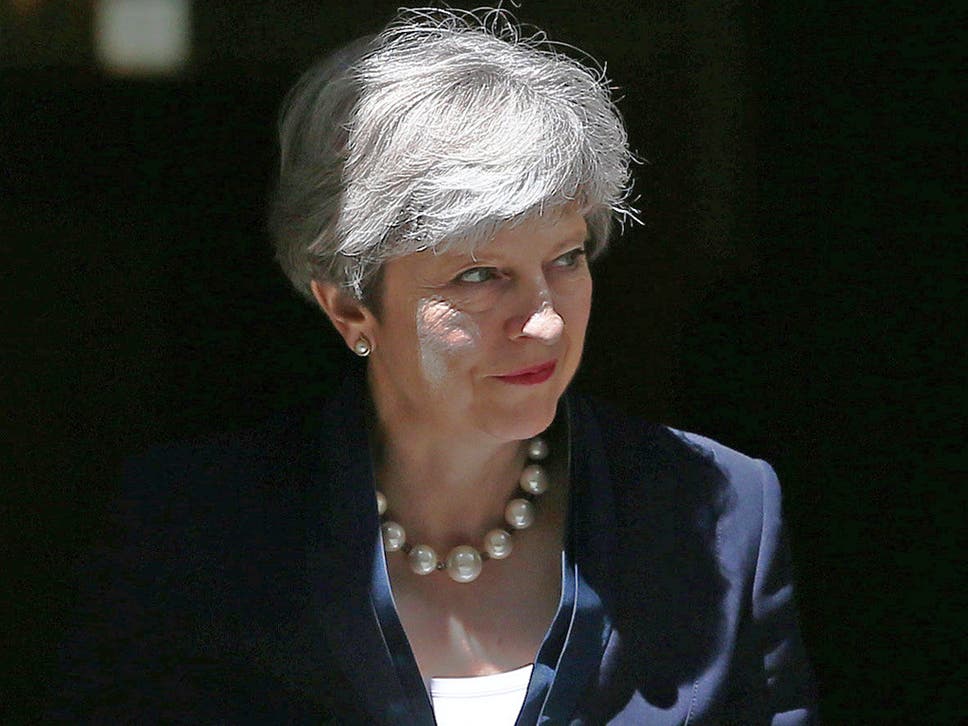
Theresa May, who brought us the hostile environment, the "citizens of nowhere" speech, and the Windrush deportations, has struck again. This time, trying to sell her embattled Brexit deal to the public, she has said it will stop EU citizens from "jumping the queue" ahead of "engineers from Sydney or software developers from Delhi".

This is offensive nonsense. There is no queue; EU citizens have exercised a right of free movement guaranteed by international treaty. But it's revealing of the aims and likely outcome of Brexit.

Theresa May. Source: The Independent/Reuters

What does May mean by this phrase? Of course, some of it is tribal signalling, almost beneath the level of spoken language. "Britain good, Europe bad" is the crude subtext. For this purpose, she might as well be flinging her own feces at a European flag. But there's something more interesting going on here.


Monday, 15 October 2018

What Is This I Cannot Even

Reading the news seemed a harmless habit, even virtuous; but that was before the world went wrong.

I miss the old days, when we could be concerned about a stained blue dress or a guy eating a bacon sandwich. Paying attention to current affairs is becoming too much to stomach.


Blogging here has been light for a while, and nonexistent for a month. That's partly because I'm still settling into my new life in Toronto. Maybe some of it is blog fatigue, after four years of posting on a weekly basis. But mostly it's just... how do you react to absolute and total madness?

Sunday, 11 June 2017

UK Election Explained for Americans and Other Aliens

By request, I am attempting to explain the 2017 UK election to Americans and others unfamiliar with the weirdness of British politics. This is a high-speed tour of:
  • How British elections work;
  • Why this election happened in the first place;
  • Why it turned out as it did;
  • What the results mean.
The UK has an archaic, complicated and illogical system of government, so what follows has been drastically simplified. I've tried to give a balanced view, steering clear of partisan bias, but other opinions are available.


The Palace of Westminster, home of the UK Parliament.


Wednesday, 7 June 2017

The Good, the Ugly, and the Astoundingly Bad

Thoughts on the major UK-wide parties, as we enter the final days of the campaign:

Liberal Democrats


I am voting Liberal Democrat. My reasons for backing them in 2015 still stand. I agree with their principles, more so than any other party. Their candidate, Julian Huppert, was an exemplary MP for Cambridge from 2010-15 and I would be happy to see him return to Parliament.

The shadow of Brexit hangs over everything now. I believe it is a dreadful mistake. The LibDems promise a referendum to allow us to reverse it.

I encourage anyone in a constituency with a viable Liberal Democrat candidate to support them. More Liberal Democrats in Parliament would provide a badly needed voice in support of human rights; accountable government; and international cooperation, including but not limited to the European Union.


Friday, 19 May 2017

Counterfactual

What if Tony Blair never went to war in Iraq?

I've been thinking about this question, in the context of Brexit and the general election. How might things be different by now?

Demonstration against the Iraq War in Universe Alpha.

Friday, 12 May 2017

Nice Guy Syndrome

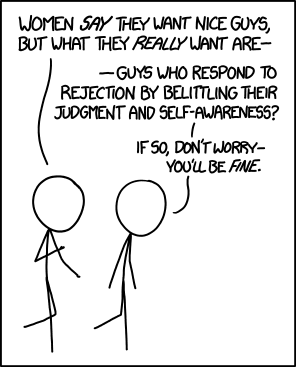
The Nice Guys Finish Last trope is widespread in popular culture, and I've come to realise it applies to the Labour party.

In this trope, women go for the arrogant bastards instead of unsexy nice guys. Sometimes the "nice guys" in question become angry, bitter, and in fact not nice at all, as illustrated by XKCD:

Source: XKCD
Labour is clearly entering the "angry and bitter" stage of Nice Guy Syndrome.

Friday, 28 April 2017

The Useless and the Cruel

This is an extraordinary election. On the one hand, we have cruel but competent Tories; on the other, well-meaning and inept Labour. The Tories are not widely loved, but it's unclear if Labour could even function as a government.

A recent column by George Monbiot acknowledges Labour is incompetent, but claims it doesn't really matter:
I would love to elect a government led by someone both competent and humane, but this option will not be on the ballot paper. The choice today is between brutal efficiency in pursuit of a disastrous agenda, and gentle inefficiency in pursuit of a better world.
Monbiot is wrong. To see why, let us consider the word "humane".

In order to be humane, it is not enough to have good intentions. If I sit around thinking nice thoughts while my child goes hungry, that is not humane behaviour. Being truly humane requires action and hard work.

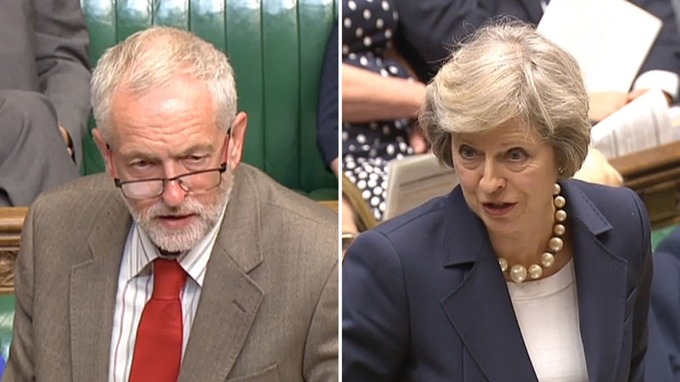
Jeremy Corbyn and Theresa May.

Friday, 21 April 2017

Waiting for the Hammer to Fall

It is not surprising Theresa May has called a general election. She is likely to secure a crushing victory, such as very few Prime Ministers have done before her. For the rest of us, the news is not so good.

Image source: Wikimedia Commons


The Conservatives have a current majority of 16, based on a 6.5% lead over Labour in 2015 with a feeble 37% of the popular vote. Polls now give them a 20-point lead over Labour, and 44% of the vote, for a predicted majority of 134.

To put this in perspective, there were 19 general elections between 1945 and 2015. Only four of them had a government majority larger than 134: 1945 (Lab 146), 1983 (Con 144), 1997 (Lab 179), and 2001 (Lab 167). May is on course for a historic landslide.

Source: Electoral Calculus, polling from 11-18 April

I think this will be an awful result. The Conservatives are a mean party, in both senses of the word: Cruel and petty. Their expected victory will give them a free hand to victimise the poor, the sick, the disabled, and immigrants. As I've recently discussed, the Conservatives celebrate cruelty as a virtue; one they value above economic success. This does not bode well for their conduct of the Brexit process.

All the same, the early election has a certain democratic logic. The referendum result has instigated Brexit, but the ballot paper said nothing at all about what kind of Brexit we want. In theory, the general election gives us a chance to decide just that.

In practice, we are caught between multiple devils and the deep blue sea.

The Conservatives offer cruelty, but also decisiveness. They will not make many decisions I agree with; but I must admit, they are largely united, and capable of setting policy and carrying it out. They are able to function as a government. It's not clear that any other party can.

The Scottish National Party will keep their grip on Scotland. The more dysfunctional Westminster is, the more it bolsters their demand for a second independence referendum. I don't blame them -- they are perfectly clear that independence is their overriding priority -- but it means they are unlikely to take a constructive role in the government of the UK.

The Liberal Democrats are unequivocally opposed to a hard Brexit. For that alone, I would probably be willing to give them my vote. As it happens, I agree with them on most other issues too. I will gladly support them as I did in 2015. Their former MP Julian Huppert is standing again here in Cambridge; he has a good chance of winning, and I hope he does.

On a national scale, though, Liberal Democrat victories are likely to be no more than symbolic. They have been reduced to a mere nine MPs. If they triple or quadruple their representation, it would be very impressive; but it would do little to dent the expected Conservative majority, especially since many of their potential gains are at the expense of Labour or the SNP.

Even with Labour in disarray, and a clear contrast with the Tories on Brexit, the LibDems are stuck at 10% or so in the polls. I think there will be a hard ceiling on LibDem support, because they simply are not trusted. Voters have not forgotten their coalition with the Conservatives, and their broken promise on tuition fees. Maybe this is unfair, but politics is not a fair competition.

Comrades, we should be struggling together


As for Labour... well, I hardly know where to start.

Prime Minister Corbyn? Really? He's a woefully incompetent leader, and his party quite plainly can't agree on what day of the week it is. Less than a year ago, eighty percent of Corbyn's own MPs voted no confidence in his leadership, and his personal popularity is abysmal. In the latest YouGov poll, 50% think Theresa May would be the best Prime Minister, next to a pitiful 14% for Corbyn. "Don't know" is beating him by a factor of more than two to one.

Labour has published a list of ten pledges. They sound... nice. I mean, who isn't in favour of full employment, improved social care, and protection for the environment? But positive change does not come about solely from the power of good intentions. It requires both ruthless efficiency, and an ability to negotiate and compromise. That does not sound like today's Labour party.

If Labour really means to do this, it's the most ambitious programme for any incoming government since 1997, maybe since 1945. Blair and Attlee had united and fiercely disciplined parties, and landslide majorities in Parliament. Corbyn will have neither.

If by some miracle Labour wins a slender majority, I don't believe they are remotely capable of implementing their pledges. They might as well have promised to ban rain on bank holidays, for all the difference it makes. We would see a weak and divided government, flailing helplessly in the face of the slightest challenge. In some respects that might be preferable to the Tories, but it's hardly surprising most of the electorate doesn't see it that way.

The ten pledges are notable for their failure to mention Brexit. How will Labour handle the central issue of this election? I have no idea, and I strongly suspect the Labour party doesn't know either.

As for Jeremy Corbyn and John McDonnell trying to negotiate a comprehensive trade deal with the European Union... my mind is well and truly boggled. These are not detail-oriented people, and their preferred approach to capitalism is shouting angry slogans about it. Putting them in charge of complex, delicate, and vitally important international negotiations would be like putting a toddler at the controls of an aircraft. It's possible they would be even less suited to the task than Boris Johnson, which is really saying something.

It's a moot point anyway. Labour's chance of overcoming the Tory lead is so remote, it can only be seen through a powerful telescope. For practical purposes, we're waiting to see how large the Conservative majority will be.

It could be very large indeed. The Conservatives and their allies in the press will unleash a monstering of Corbyn such as we have never seen. His past record provides plenty of material to work with.

Labour's performance in 2015 was so poor, it doesn't have that far to fall. Its near-wipeout in Scotland entailed a 17% swing, which is unlikely to be replicated in England. It had 30% of the UK popular vote in 2015, and even in a worst-case scenario, it is likely to hang onto 20% or so.

That said, there are a lot of moving parts which can work to the detriment of Labour. Remain voters will switch to LibDems, Leave voters to UKIP or the Conservatives. Those disillusioned with Corbyn's leadership will vote for other parties or simply stay home. A great many seats could be handed to the Conservatives, even in the most unlikely places.

Current polling has Con 44, Lab 25, LD 10, UKIP 10. Let's try the Electoral Calculus swingometer with Con 48, Lab 20, LD 15, UKIP 5. This gives a Conservative majority of 216; an all-time record if we leave aside wartime coalitions, and all the more impressive with only one or two Tory seats in Scotland. Of course this is only a crude estimate, but the general point is clear.

I think the Labour party is rather looking forward to this election, because it will allow them to get on with their real objective of fighting each other.

Labour has observed an uneasy truce since last year's leadership contest, but internal grudges have not been forgotten or forgiven. After the expected defeat, moderates will blame Corbyn's incompetence, Corbynites will blame the MPs' disloyalty, and the party will once again plunge into civil war. Few outsiders will take much notice; and for good or ill, Theresa May will have almost total power to rule the UK as she sees fit.
Friday, 10 February 2017

Parliament: The Good, the Bad, and the Ugly

It's been an exciting week in the UK Parliament. Some MPs should be proud of their actions, others thoroughly ashamed. Herewith are some of the heroes, villains and victims.


Friday, 23 September 2016

Fragmentation and Despair

This week, the Labour MP Ruth Smeeth gave an interview about the racist abuse and death threats she has faced from supporters of Jeremy Corbyn. The whole thing is well worth a read. It joins testimonies from many other Labour MPs, questioning Corbyn's leadership and the behaviour of his followers, some of which I list here.

These MPs raise hard questions which Corbyn and his team show no signs of answering; except to dismiss the askers as crypto-Tories, or worse still, Blairites.

The MPs deserve a more respectful answer than that. They have decades of service to Labour, and long and impressive records of fighting for the underprivileged. I am frankly baffled by the idea that they declared no confidence in Labour's duly elected leader, because they cannot tolerate his message of kindness and solidarity. The alternative explanation, that Corbyn is failing to meet his responsibilities but too stubborn to change, is not one the party leadership cares to contemplate.

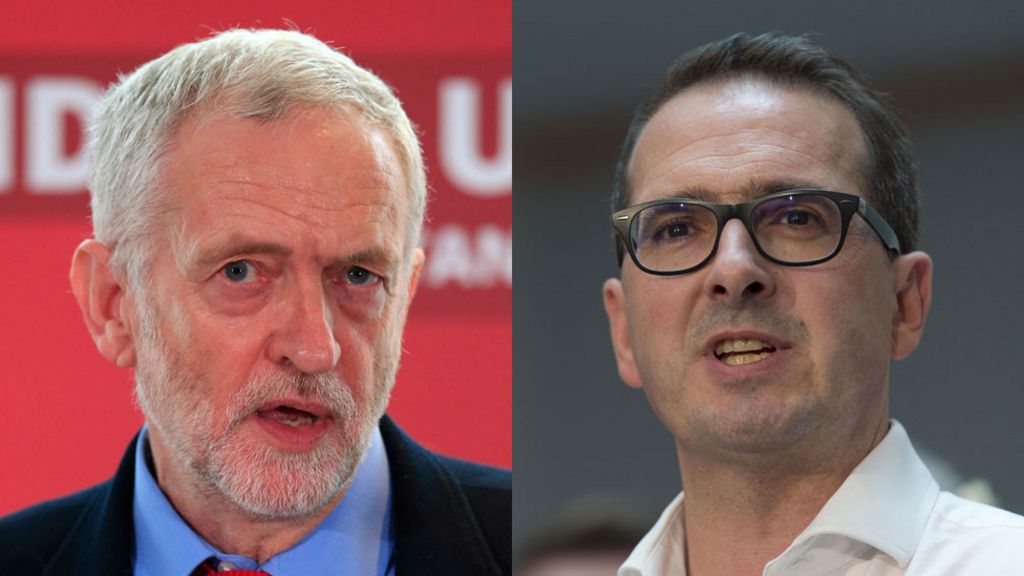
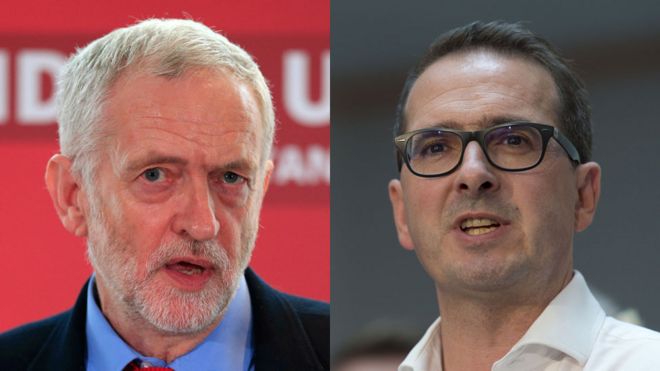
Jeremy Corbyn (left) and his leadership opponent Owen Smith (right).
Image source: BBC
Be that as it may, it seems nearly certain that the result of the leadership contest tomorrow will confirm Corbyn's re-election.

Friday, 19 August 2016

It didn't have to be this way

The Labour leadership contest between Owen Smith and Jeremy Corbyn staggers on. It's another five weeks before this time of conflict ends, and a whole new era of internecine warfare can begin.

Corbyn (left) and Smith (right).
Image source: BBC News via PA/Getty

Corbyn recently published a ten-point plan, setting out his policy priorities. It would have been nice if he did this before his party descended into civil war, but I'll give credit where it is due: It's a very good set of ideas, ambitious but achievable. Of course there are questions over the detail, but it's a respectable starting point.

Friday, 15 July 2016

Labour's Unholy War

Once upon a time, an organisation grew tired of its weak and self-serving leadership. It rejected the conventional candidates, and elected an old man from the wilderness. He was humble in appearance, ascetic in lifestyle, and uncompromising in his principles.

I am referring of course to the Catholic Church in the year 1294. At the time, the cardinals had spent two years failing to elect a Pope. They finally settled on Peter of Morena, a seventy-nine year old hermit who was enthroned as Celestine V. He was sincere, incorruptible and no doubt holy; but unable to handle the administrative and diplomatic duties of the papacy, he abdicated after five months -- the only Pope to do so until Benedict XVI in 2013.

Tomb of Celestine V. Source: Wikipedia

History does not repeat itself, but sometimes it rhymes. Corbyn was elected in a similar mood of frustration with business as usual. He looked different, sincere in his convictions, and untainted by personal greed. That set him apart from his colleagues, and it was enough to win him the leadership election. Where Corbyn differs from Celestine is that he has no intention of going quietly.

Friday, 8 July 2016

Reality and Unreality

Two major news stories of the week are connected by a simple question: What is reality?

This may seem abstract, but it has a close bearing on both the Conservative leadership contest, and the Chilcot enquiry into the Iraq War.

Friday, 17 June 2016

One Of The Best Of Us

I am sorry to say that, until yesterday, I had not heard of the murdered MP Jo Cox. I have no doubt that, given time, I would have done.

It is desperately, desperately sad that her obituary has been written when she was so young. It makes clear what a great loss she is to us all. She was a tireless campaigner for those less fortunate than herself, working for charities including Oxfam, Save the Children, and the NSPCC before she became an MP. The Conservative MP Andrew Mitchell, a man with whom at first glance she had little in common, has written a great tribute to her energy, compassion and friendship. She represented the Britain that I love, a kind, generous and outward-looking country.

Cox was killed doing her job as an MP. The attack on her was an attack on our democracy as well. The count at yesterday's by-election in Tooting, held to fill the parliamentary seat of new London mayor Sadiq Khan, observed two minutes of silence in her memory.

She leaves behind a husband and two young children. If something similar happened to my wife, I cannot imagine what it would be like, or if I would be able to say anything at all. I can only commend the courage and eloquence of her husband Brendan, who issued a deeply moving statement about Jo's death.

I am glad that Tommy Mair, the man who attacked her, was taken alive. Being shot down by the police would be too easy for him. He needs to stand in a courtroom, see the grieving family of the woman he killed, and have a long time in a prison cell to reflect on what he did.

Mair's motives are not yet clear, but eyewitnesses say that he shouted "Britain first" as he shot and stabbed Jo Cox.

If Mair indeed had far-right political motives, then those politicians who have encouraged bigotry and hatred bear a heavy responsibility. I am thinking in particular of UKIP leader Nigel Farage, who has shown his bigotry time and again, openly speculated about anti-immigration violence, and yesterday unveiled a shockingly racist poster which said immigrants are bringing the UK to a breaking point. Yes, it appears Mair has severe mental health problems. But as Alex Massie observes in a powerful article, politicians cannot talk about breaking points and then act surprised when someone takes them seriously, and reaches a breaking point of his own.

We will have time to puzzle and argue over Mair's motives. Today is a day to grieve for Jo Cox. She was one of the best of us.

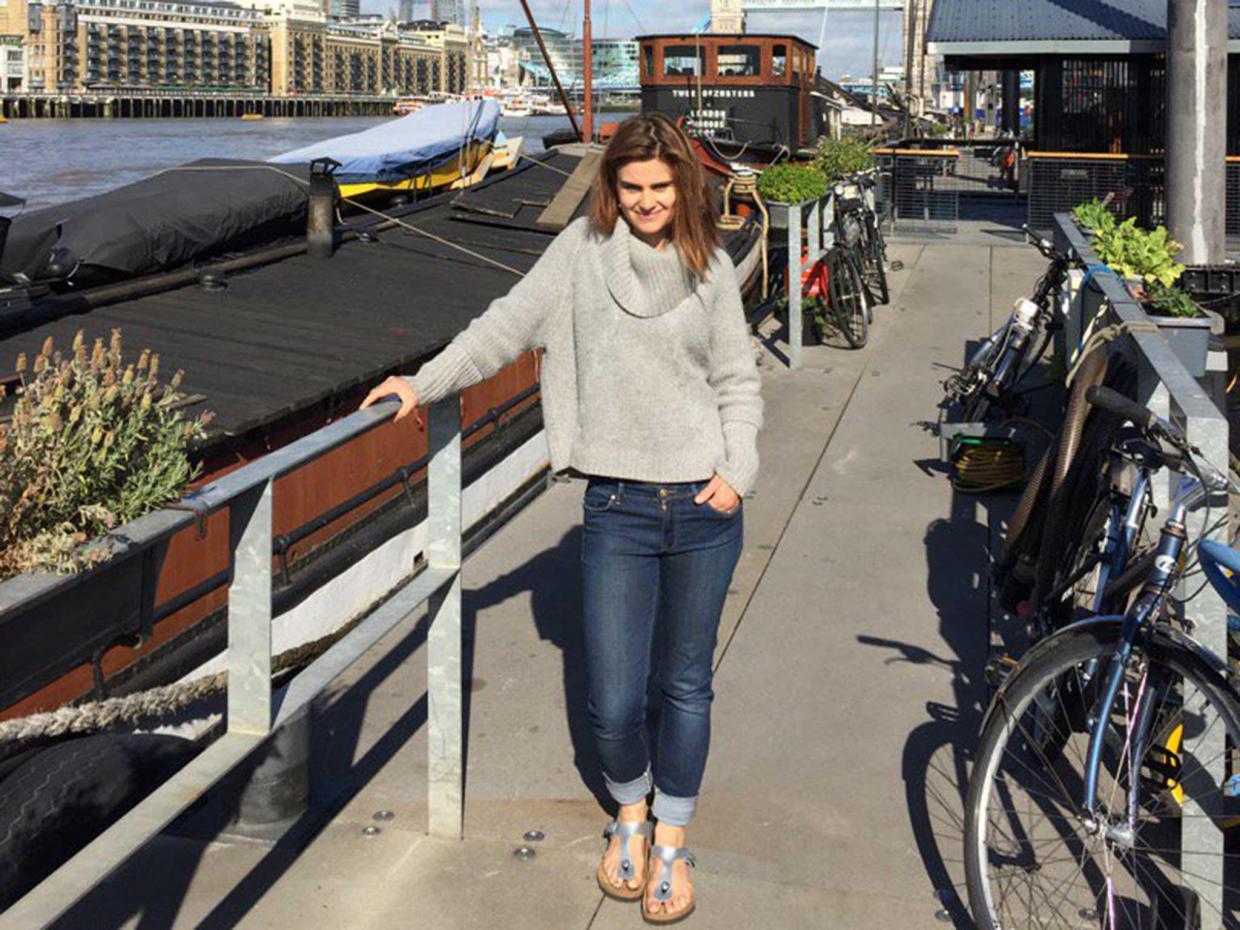
Jo Cox, 1974-2016

Friday, 26 February 2016

Sanders versus Corbyn

There are some obvious parallels between Bernie Sanders, contender for the Democratic presidential nomination; and Jeremy Corbyn, leader of the UK Labour Party. Their shared attributes include:
  • Relatively advanced age (Sanders 74, Corbyn 66)
  • Scruffy in personal appearance
  • A more natural style of speaking, as opposed to carefully scripted soundbites
  • Long-standing membership of the legislature (Sanders since 1990, Corbyn since 1983)
  • On the far left of their respective parties
  • Rose to prominence out of grassroots frustration with the party establishment
  • Tony Blair is confused by their popularity. I find this amusing, since Blair's style of rigid discipline, media spin, warmongering and indulgence of corporations is exactly what made Sanders and Corbyn possible.
The parallels have been noted by Brits trying to make sense of Sanders. Even Bernie's brother Larry Sanders, a Green activist living in the UK, has made the comparison. Other UK commentators have been more hesitant to equate the two. For their part the Americans have barely heard of Corbyn; they have plenty of weirdness closer to home.

Jeremy Corbyn (left) and Bernie Sanders (right).

Wednesday, 27 January 2016

Election Stories 2: The Labour Party

Part One looked at the narratives of the big winners and smaller losers in the 2015 general election. We now turn to the Labour party.

So, what was Labour's story in the last election? As far as I can tell — and I'm trying to be generous here — it was:

Mumble mumble squeezed middle burble rail fares something utility bills.

Ed Miliband thought a manifesto was a substitute for a story. There were some worthy policies in there, but no inspiring narrative.

When Miliband condensed his offer down to six bullet points, they were positively embarrassing, even before he had them carved onto a big lump of rock. Campaigning for a strong economy isn't a story; it's like saying kittens are cute and chocolate is delicious. That's very nice, but it's no reason to give away the keys to a whelk stall, let alone 10 Downing Street.

Thursday, 17 December 2015

Where Eagles Dare

An incident from last month illustrates the depth of Jeremy Corbyn's problems, which have not abated since.

Angela Eagle in Parliament this month.

Angela Eagle MP is the Shadow Business Secretary; in addition, as Shadow First Secretary of State, she deputises for Corbyn at Prime Minister's Questions when he is absent. So it is quite extraordinary that Eagle will not say if her party leader is fit to be Prime Minister:

Asked again if [Corbyn and McDonnell] were suited to highest office [Eagle] said: “I work with people the party gives me to work with. 
“We all have our strengths and weaknesses and the point of having a party is that you can bring together the collective wisdom and that’s what I’m in the middle of doing. It’s one of those questions that you want me to answer in a certain way so that you get a headline out of it and I’m not playing that game this morning."

Consider the Leaders of the Opposition in recent elections: Kinnock, Blair, Hague, Howard, Cameron, Miliband. In the country at large, some were better liked and more successful than others. But if you asked any of their shadow cabinet colleagues whether they were fit to be Prime Minister, the answer would have been a firm, unhesitating "yes".

For some, that answer would not have been the whole truth. In the case of Hague or Miliband, their colleagues must have had more than a few doubts. In private, they might have added, "At least, I bloody well hope he's up to the job." But in public, for the TV cameras? In a functioning opposition party, the only answer is, "Yes of course, our party leader would make an excellent Prime Minister."

A possible exception is Iain Duncan Smith, and he was defenestrated before he had the chance to lead his party into a General Election. History may or may not repeat itself for Corbyn. Either way, Labour is in deep trouble.

The fact that Eagle considers it a trick question, instead of a trivial one, speaks volumes about the state of the Labour party. Corbyn can't sack her from the Shadow Cabinet for such rank disrespect, because who could he possibly replace her with? He has few enough MPs willing to serve in shadow posts as it is.

It also leaves Eagle unable to answer an obvious follow-up question: If you won't say whether your leader is fit to be Prime Minister, why should we vote for any of your lot?

There's plenty of blame to go around for this sorry situation. I expect it will get much worse for Labour, before it has any chance of getting better.

Friday, 9 October 2015

King Over The Water

Let's imagine for a moment that Jeremy Corbyn fails to sweep all before him.

(Some Corbynistas may take the very suggestion as an insult, but that's too bad.)

Suppose it's a few months before the 2020 election. Maybe Corbyn is still leader, or maybe he has been deposed. Either way, opinion polls predict heavy losses for Labour and a landslide Conservative victory. The writing is on the wall: Labour will lose badly, and there will be a vacancy for the position of leader.

No, not this king over the water.
At this point, I would expect the centrist elements of Labour to start pushing for former Foreign Secretary David Miliband to return to UK politics. He sat out the defeat of his brother Ed, and hypothetical calamities under Corbyn, doing good works as head of the International Rescue Committee in New York. He would have the unique combination of senior government experience, and almost complete disconnection from Labour's decade in opposition between 2010 and 2020.

David Miliband will be 55 years old, and could try to find a safe seat for the 2020 election -- although Scotland has demonstrated the concept of a "safe seat" is not what it used to be. On the other hand, to wrap up the family soap opera, brother Ed's seat in Doncaster might become vacant.

The main difficulty for the hypothetical Draft David movement is this: Miliband may not want to run for leader again, or take on the task of trying to salvage something from the post-Corbyn wreckage.

I'm raising this possibility not out of any particular liking for Miliband, but because the parliamentary Labour party is likely to be pretty desperate. There aren't many other plausible leaders.

Cooper, Burnham and Kendall have just had their chance and been soundly beaten by Corbyn. Chuka Umunna withdrew from the race this time for personal reasons, and may not wish to try again. There are some talented new MPs such as Keir Starmer and Dan Jarvis, but they might be considered too inexperienced. Who else is out there, really? Could Ed Balls end up being the standard-bearer for the centrist tendency of Labour?

This raises another line of speculation. Balls lost his seat in the general election. He could try and fight a by-election to return to Parliament as soon as possible, but it wouldn't surprise me if he was in no hurry to serve as an MP under Corbyn. He might find himself another job for the next five years and aim to return as an MP in 2020.

Maybe Corbyn will be a stunning success and render all of this moot. If not, you read it here first: We might have a Prime Minister Miliband after all, just a decade later than we first thought.

Thursday, 24 September 2015

On Anthems

Pig note: Last week's anthem scandal seems distinctly tame in comparison to the new story involving David Cameron and a farmyard animal. The Cameron story is hilarious, but he won't be running to be Prime Minister in 2020, and Corbyn presumably will.


In one of his first official engagements as Labour leader, Jeremy Corbyn caused much consternation by refusing to sing God Save The Queen. The outcome says a lot about both the national anthem and Corbyn, most of it not very good.

Corbyn stood in what he described as "respectful silence" during the national anthem at a service commemorating the Battle of Britain. When questioned about it, Corbyn conspicuously avoided committing himself to singing the anthem at future events, instead saying he would "play a full part" in them. Labour party spokespeople claim this means he will in fact sing the anthem; but considering how chaotic Labour's communications have become, I am disinclined to take them at their word.

The usual suspects have said and written a great deal of overheated nonsense about Corbyn's silence. It doesn't mean he loves his country any less than they do. What it does indicate is Corbyn's complete lack of interest in media strategy.

At the time of this event, Corbyn had been Labour leader for less than a hundred hours. He was still introducing himself to the great majority of voters, who don't follow politics closely. A lot of people wondering who this Corbyn chap is, and what he's all about, would have encountered this:

Image source: The Guardian